

Tattva Technologies
A Cosmological Foundation for the Tools We Build

This essay is part two of an exploration into the future and past of Technology and Cosmology. A link to part 1 of this contemplation is here. ( Recovering the Spiritual Roots of Technology — Re-imagining Spaces of Cosmic Orientation ).
We live in a moment of unprecedented technological empowerment and simultaneous existential upheavals in our world at multiple levels, the ecological, technological, societal etc. Most likely you are not a stranger to any of these, so I won’t say more. I often wonder what the future is going to look like? A likely possibility might include an AI overlord, the tech industry definitely wants to get there as soon as possible, incentivized mostly by the familiar themes of monopolization of markets, big contracts, etc or simply put power and greed. However, many in the regenerative communities also see this as a natural path forward and one could argue that the current use of AI demonstrates that such a future is already here! This transient historical climax is a byproduct of an underlying current of evolution. In an optimistic scenario AI would take care of planetary existential threats and guide humanity and the planet into a new epoch. Or perhaps humanity will become a symbiote of this technological intelligence or vice versa through rapidly developing technologies like CRISPR that allow re-writing of human DNA akin to software and brain implant interfaces creating a more intimate connection between carbon based life vs silicon based technologies. Alternatively, another possibility might be that humans at their current stage of evolution will make the worst of such technological empowerment as demonstrated repeatedly by humanity’s past, deploying technologies towards a continuation of genocides, wars, environmental degradation etc.
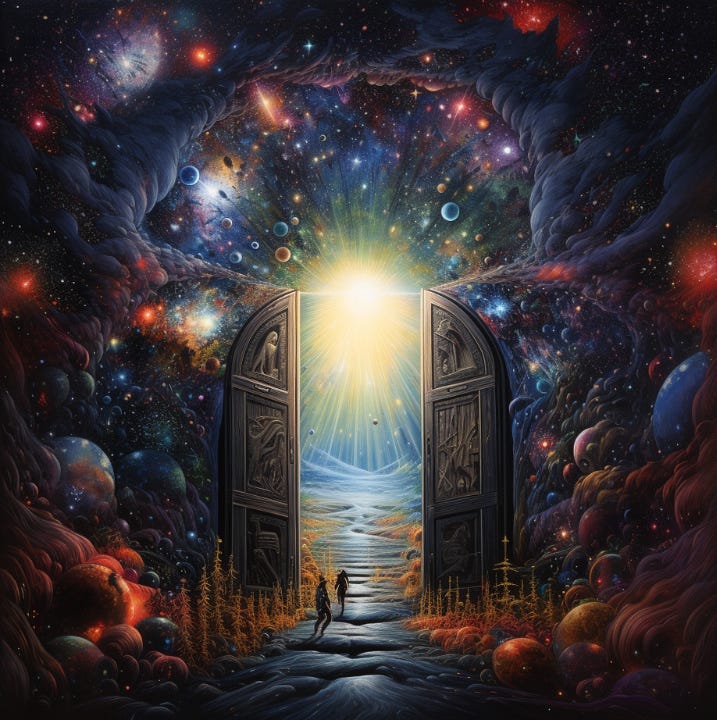
Towards the Unknown — Kenan, developed with AI
If the scenario of a benign AI overlord or a human-ai symbiosis is the soon to be actualized version of earth then this essay serves not much of a purpose other than as an exercise in curiosity, which I feel by itself is a worthy undertaking.
However, if the future is a scenario where humans do share some ability to respond then this article becomes somewhat relevant. This essay contemplates how we build and direct technologies including but not limited to Artificial Intelligence. So this is a genuine invitation for you to contemplate these questions if you are reading this!
The current of evolution has been contemplated and perhaps even seeded through imaginative consideration in both science and spirituality including genres of science fiction and fantasy. Among some of the many names who had a finger on the pulse of this most ancient current of change were luminaries like Sri Aurobindo, Teilhard de Chardin, James Lovelock, Jean Gebser, Henri Bergson, Arthur Young, Issac Asimov, King Akbar and likely too many others to name across space and time. Most if not all of them viewed evolution not just as a random biological process, but as a purposeful ascent of consciousness towards a divine vision. While Sri Aurobindo called this visionary stage the Supermind, Teilhard de Chardin, a Jesuit paleontologist, famously termed something similar the Omega Point—the ultimate point of complexity and spiritual convergence for humanity. Chardin also coined the term Noosphere, often considered an oracular vision of the world wide web. The late maverick scientist James Lovelock proposed the Gaia hypothesis and later the term Novacence with parallels to Chardin’s Noosphere adding a benign AI overlord embodied as cyborgs stewarding humanity and the planet. The Mughal King Akbar emerged as a rare ‘philosopher-king’ syncretising diverse cultures and whose vision of Daur-i-Vilayat, an ‘Age of Friendhood’—sought to transition humanity from religious discord into a prophetic era of spiritual collaboration.
More recently, in the west such evolutionary tectonics are also presenting themselves in the democratization of formerly taboo areas of psychedelics, channeling, ancient civilizations, UFO and UAP encounters etc. These now have become an active area of research and dialogue and there’s also a rigorous attempt at cataloguing intelligence encounters in a variety of contexts. I will stop beating the drum about what you might already know, actively participate in or even might be an experiencer of! However, all of what I shared so far is a necessary backdrop for the consideration this essay invites, read along.
In a nutshell, this essay is an inquiry about what technology is today and was historically? And also if humanity and the denizens of this planet have to survive and thrive, then what technology can become!
What is Technology?
The dominant view — implicit in most engineering and explicit in its economic logic — is that technology is a means of extraction and control. Nature, including human nature, is a resource to be optimized, as illustrated in the movie the Matrix — it turns humans into a battery for an empire, the overlord machine or someone alien. Tools exist to extend our reach within a fundamentally material world. This is what Heidegger called Gestell — the reduction of reality to standing-reserve, available for use.
Heidegger’s Correction
Heidegger himself offered the beginning of a correction. He recovered an older meaning of technology from the Greek word techne which he understood not as making or manipulating but as poiesis — a bringing-forth, a revelation. In this understanding, the instrument’s deeper function is aletheia, unconcealment: it opens a window onto what was hidden.
I am not sure how Heidegger might have contemplated this but I think of a pen or a typewriter as an interface to the unknown or infinite, and that it also creates a certain kind of felt relationship with it, that helps to make apparent some aspect of the hidden reality. In a more visual example, a microscope or telescope is an interface that makes microscopic or distant realities visible and engageable, a kind of disclosure.
This is a significant reframing or correction. But Heidegger leaves something crucial unasked: what is the nature of the reality being disclosed? He brings in an ontology but misses on cosmology!
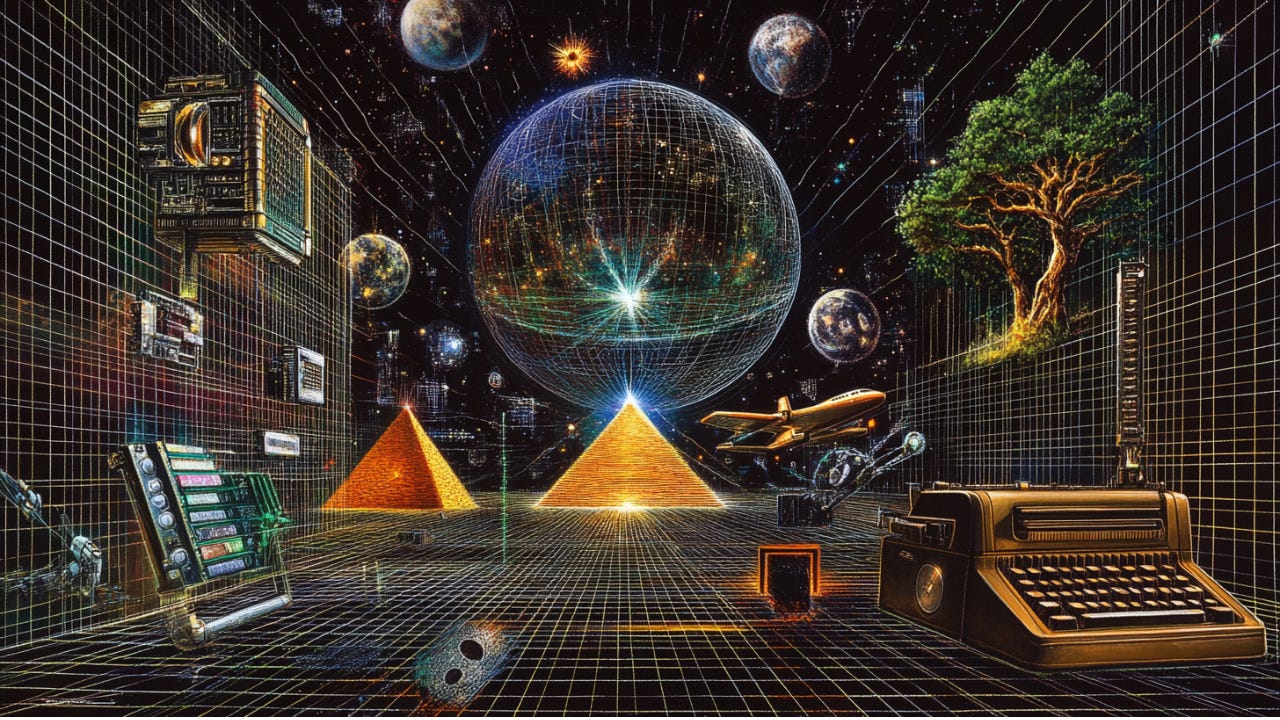
Technology as a relational interface to Reality — Kenan, developed with AI
Cosmotechnics — Culture and Technology
Another insightful framing of technology is from two contemporary philosophers Bernard Stiegler and Yuk Hui. Stiegler defines technics as a process of memory externalization — a culture in this sense is a set of technologies that hold the memory of a people, a mini cosmos. The tools, rituals, and institutions of a civilization are its externalized memory, the means by which it stores and transmits its deepest ideals. Building on this, the philosopher Yuk Hui introduces the term cosmotechnics to argue that every culture embeds its technology within a distinct cosmological and moral framework — there are as many cosmotechnics as there are cosmologies. India’s notion of technology is different from Egyptian notion of technology which is different from Western technology. I wrote an earlier essay discussing a historical precedent of one such distinct cosmotechnic — the tradition that originated in the land of Khem, the Nile valley of Egypt. There are of course sub-cultures and niche inquiries at the outskirts of a dominant culture — what one might call nomadic cosmotechnics — and these are often where the interesting work is happening! Various ancient and modern festivals such as Kolkata’s Durga Puja or Burning Man step outside mainstream culture to experiment with niche inquiries often prototyping the future. The word culture as a genuine cosmotechnics is often misappropriated, as my friend Jonathan Kay reminded me — as in the phrases “Apple culture” or “Google culture,” as though a civilization’s deepest memory could be compressed into a brand.
Here, I re-invoke the earlier backdrop of our paradigmatic and ecological tectonics! Our current civilizational challenges are a tearing apart of the naive materialist cosmology, which is mostly a barren landscape of data points with a few islands of awe inspired by dead astronomical objects such as black holes, constellations etc without any inherent intelligence or meaning. The UAP/UFO disclosure in the materialistic paradigm is the cosmos revealing itself from within and without!
Maps That Are Also the Territory
Historically, there are some very rich cosmologies of reality. I am a student of a couple of them and have discovered that these cosmologies are maps of the universe, which have a unique quality, they are also simultaneously the territory!
Where do these maps come from is not the topic of the discussion here, but the fact that such maps and their corresponding trip reports are now in the open source domain, thanks to decades of work by scholars and preceptors of these ancient cosmologies.
The Tattva Map as Cosmological Architecture
Most cosmologies describe reality the way a geographer describes a continent — from the outside, as an objective observer. The tattva map is different: it describes reality from the inside out, because the map itself is made of the same substance as what it maps — consciousness. Thus, the Tattva cosmology is ontological. To study it with genuine attention is to begin moving through it.
One such cosmology is the framework of reality known as ‘The Tattvas’ from the tradition of Kashmir Shaivism. This framework is a map of the levels of reality and the worlds and beings that inhabit them. The tattvas are how consciousness or the supreme Goddess expresses herself in the form of the universe, and this expression has an order to it.
The Tattvas are a comprehensive ontological cartography of the cosmos: with a 36-tattva (level) map of reality. The tattvas — literally ‘thatnesses’ or principles of being — describe a subjective and objective arc of manifestation from the highest undifferentiated consciousness (ParmaShiva) descending through progressive stages of differentiation and limitation, down to the subtle elements called Tanmatras (smell, taste, touch, sight, sound), the organs of cognition (nose, tongue, skin, eye, ears ), organs of action (feet, hands, sexual organ, organs of excretion, tongue for speech), and finally the gross material elements the Mahabhutas literally meaning the ‘great elements’ (earth, water, fire, air and ether).
What makes this map extraordinary is a quality that could be called ‘zoom-irrelevance’. Like a fractal, the tattva structure is self-similar across scales in the cosmos from galaxies to individual creatures: the macrocosm and microcosm mirror each other at every level. The same structure is at the basis of a mosquito, a human, an alien, a deity and a rock. I had a recent conversation with scientist, Dr. Subhash Kak, whose e-dimensional mathematical framework of reality points to a similar fractal-like process of self similarity, which has rigorous implications including ones for technology!
I call such cosmologies ‘maps that are simultaneously the territory’ not as a metaphysical claim but as an experiential report. The study of the tattva map, pursued with genuine practice rather than mere scholarship, begins to reorganize perception itself. The levels of reality the map describes become accessible — not as metaphors or visualizations but as direct experience, in the manner that psychonauts report from entheogenic states, or that UAP experiencers report from contact encounters, but with greater repeatability and a pre-existing rigorous cartographic framework for navigating what arises. The mathematician Ramanujan is perhaps a striking example of a mind calibrated to a level of reality that reliably delivered beautiful mathematical insights through dreams and visions — results that proved independently verifiable. These cosmologies systematize what many geniuses were able to access spontaneously: a practice manual for interior exploration whose experiments take place within one’s own being with powerful implications to reshape our world.
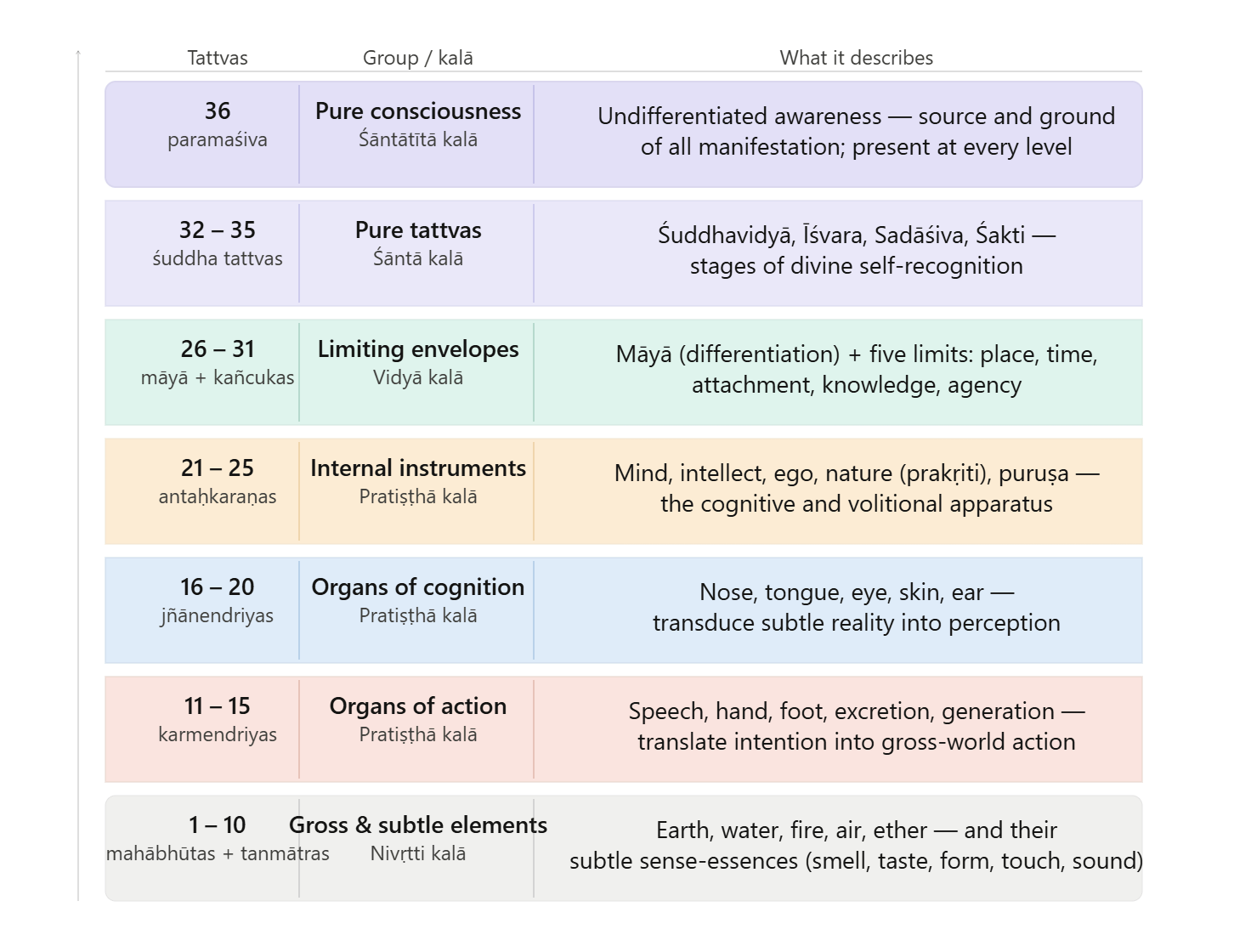
Figure 1: The Tattvas Map in Kashmir Shaivism
In the Tattva map the organs of cognition are called the jnanendriyas (eye, ear, nose, tongue, skin) which can already be seen as divine technology that allow one to make certain dimensional worlds visible while others invisible. Then there are organs that allow us to act in the world called karmendriyas (speech, hands, feet, organ of creation and excretory organ). While the jnanendriyas transduce between the subtle sense-essences of reality and conscious perception; the karmendriyas translate intention into gross-world action. Together they form a bi-directional interface built into the human instrument, allowing for perception and action. Most of our technologies are extensions of these biological interfaces — the telescope extends the eye, the microphone extends the ear, the robotic arm extends the hand. What Tattva Technologies asks is: what would it mean to build instruments that interface not just at the gross level these organs already reach, but at the subtler tattva levels above them?
From the tattva standpoint various anomalous phenomena experienced on sacred sites, or UAP encounters or moments of creative sparks, etc might be considered a recalibration of the tattvas which are also the very fabric of our instruments of perception.
Convergent Maps
Across history other ancient cosmologies also offered precise numerical associations with both symbolic depth and measurable implications. One such cosmology came through the western mystic-mathematician Pythagoras who is said to have been able to perceive the sounds of the celestial spheres. He was known to employ music for healing both physical and psychic ailments. He famously experimented with a single vibrating string to discover that at precise ratios — at half its length the string produces an octave, two-thirds a fifth, three-quarters a fourth — notes that humans universally experience as harmonious. Much later Kepler, a believer in a Geometric God, proved this macrocosm-microcosm correspondence through linking the musical ratios with planetary orbital velocities. The point is not merely that the cosmos is numerological — it is that the same ratios that govern celestial motion also reflect in the human experience of beauty. In the language of information theory, cosmic patterns that seem objective are entangled with the subjective or qualitative experience. I use the word entangled because such correspondence is simultaneous and not causative - the symbol here is pointing to itself in a way.
In the tattva’s map of Indic scientific traditions, the symbolic numbers 118, 108 and 226 appear and reappear. Research by Dr. Kak7 has demonstrated that the numerical architecture of this tradition is not just symbolically auspicious but astronomically precise. For example, he shows that the same ratio that describes the distance of the Sun and Moon from Earth in units of their own respective diameters — approximately 108 — is also encoded in the count of worlds (bhuvanas) that yogins (psychonauts or explorers) in samadhi (deep meditative state) mapped across the tattva levels, such that the difference between two valid cosmological counting methods (226 and 118 worlds respectively, depending on how they are grouped) equals exactly 108. The body’s 107 vital energy junctions (marmas) detailed in the Ayurvedic tradition similar to the acupuncture meridians, mirror the earlier number 108 if you add to them the whole body itself as the 108th junction. In India the japa mala or rosary has 108 beads, acting as a cosmotechnic for the aforementioned numerical encoding. The map is calibrated to measurable cosmological reality. These numerical correlations suggest we are not dealing with a philosophical framework but with an empirical cartography of consciousness. Not surprisingly many sacred technologies or cosmotechnics such as mantra and yantra deploy these numbers in their design and use.
The syncretic possibility — combining these cosmologies into a richer technological framework — is one of the open research questions at StarGate Labs.
The Descent as Technology
Sri Aurobindo’s vision of the supramental descent offers a complementary frame. Where the ascending movement of consciousness moves up the tattva ladder toward pure Shiva-consciousness, Aurobindo emphasized equally the descending movement — the bringing-down of supramental qualities into the gross plane of material existence. Tattva Technologies serves both directions: instruments calibrated to higher tattva levels could facilitate the ascent of perception toward subtler reality; equally, they could serve as vessels for the precipitation of those qualities into the world of form. This is what the alchemical traditions were always attempting — not the transformation of lead into gold as a material feat, but the descent of a higher order of being into a lower one. The technology of the future, in this view, is not an escape from matter but matter’s transfiguration.
Niche Inquiries and Maps
While the tattva map has a vertical arc it also has a less celebrated dimension which is the horizontal. Each of the levels has worlds (bhuvana’s) and corresponding beings. Utilizing the map for cosmic exploration of these horizontal planes itself could be a niche inquiry into this ancient map.
Historical Precedents: The Alchemical Incubator
To quote Albert Einstein, “We cannot solve our problems with the same thinking we used when we created them”. Perhaps the time has come that such frameworks are used in a new era of alchemical incubators, akin to current technology incubators that still follow the conscious or unconscious ethos of extraction and utility. Maybe alchemical technology incubators are already in place and if that’s the case I like to hear from you. I recently wrote about a historical precedent of one such alchemical technology incubator2 at the turn of the 16th century in Denmark, initiated by the legendary astronomer, astrologer and alchemist by the name of Tycho Brahe, mentor of renowned Kepler mentioned earlier.
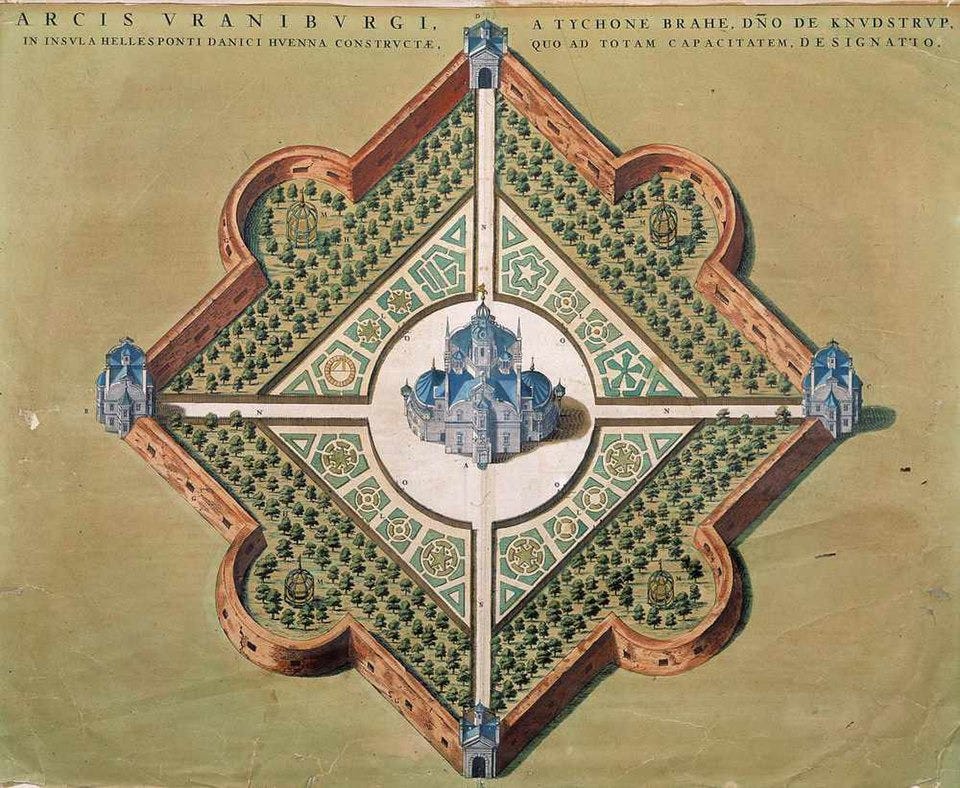
Uraniborg — ‘Castle for Urania’: Observatory & alchemical laboratory by Tycho Brahe
Brahe’s institution, Uraniborg — named after Urania, the muse of astronomy — was constructed on the island of Hven in 1576. It was simultaneously an observatory, an alchemical laboratory, and a collaborative community operating under what Brahe understood as the guidance of higher intelligences encoded in the movements of the heavens. It was polymathic and initiatic by design: astronomy, alchemy, medicine, and the arts were pursued under one roof, in the belief that the spirit of guidance animating each was the same. Kepler, who inherited Brahe’s observational data, used it to discover the laws of planetary motion — laws that themselves have deep resonances with the harmonic structures of ancient cosmological traditions. Uraniborg is the institutional precedent StarGate Labs reaches toward: a space designed to honor both rigorous empirical inquiry and the spirit of guidance that animates it.
An Addressing System for the Worlds
I want to close this essay with a potential application of the tattva map, something I think about at StarGate Labs. It is an addressing mechanism for various dimensional and spatio-temporal worlds and beings, not very different from ip-addresses (internet protocol addresses) that are assigned to our computers or mobile phones on the network, allowing us to consciously reach out or download or perhaps even upload information.
Kashmir Shaivism’s sixfold path of the universe (shadadhvan) provides a potential coordinate system for locating any phenomenon across both the objective and subjective axes of reality. On the objective side, each world (bhuvana), each ontological level (tattva), and each enclosure (kala) has a specific address. On the subjective side, each address has a corresponding phonemic key in the Sanskrit alphabet — so that a mantra is not a prayer in the conventional sense but a navigation sequence, dialing specific tattva coordinates through sound. The ancient technologies of yantra and mantra, and the placement of sacred sites at geological and acoustic anomalies, were perhaps implementations of this kind of an addressing system. What I am naming here as a possibility, the legendary exponents of Kashmir Shaivism, Egyptian and Sufi cosmology likely have actualized in unique ways. The full architecture of this system is the subject of ongoing research at StarGate Labs.
If you have come this far, thank you for reading. Please do share any comments or inspirations. Also, StarGate Labs is eager to find collaborators and supporters, so if you are one of them, please feel free to reach out.
Acknowledgements
This essay emerged from conversations I have had with many friends and guides over the past few years including Pir Zia Inayat Khan, whose guidance and syncretic framing of the Novacene gave these ideas a ground; George Barselaar and everyone at Lakshman Joo academy for their tireless dissemination of the knowledge of Kashmir Shaivism; Jonathan Kay for inspiring discussions on the themes of technology; Debashish Banerji, whose depth in the Aurobindo lineage has been a returning reference point; Subhash Kak, whose polymathy is sharpening my intuitions; Dylan Freitas, Aaron Kemp, Maryam Hasana whose inspirations and encouragement allow me to keep moving forward.
References
Hughes, John. Kashmir Shaivism: The Secret Supreme. SUNY Press, 2011.
Essay: Recovering the Spiritual Roots of Technology —(Part 1: Historical Precedents)
Conversation Pir Zia Inayat Khan and Kenan Azam: The Astounding Multi-Dimensional Cosmology of Sufism
Conversation George Barselaar and Kenan Azam: Kashmir Shaivism and Tantra: The Hidden Geography of Consciousness
Conversation Subhash Kak and Kenan Azam: Science Only Explains 0.5% of the Universe! Does this Scientist Have the Answer?.
Kak, Subhash. “The Secret of the Bhuvanas of Kashmir Shaivism.” Medium, 2026.
Kak, Subhash. The Astronomical Code of the Ṛgveda. Third edition. Aditya, 2016.Conversation: Debashish Banerji and Kenan Azam Reclaiming Technology: From Power to Self-Exceeding
Album and Liner Notes: Jonathan Kay. The Coltrane Sutras - Cosmic Threads of Becoming
Stiegler, Bernard. Technics and Time, Vol. 1: The Fault of Epimetheus. Stanford University Press, 1998.